Is Playa Del Carmen Safe? What Tourists Should Know
Quintana Roo, the Mexican state that contains Playa del Carmen, carries a Level 2 'exercise increased caution' rating from the U.S. State Department, the same tier as Mexico as a whole. Here is what that actually means on the ground, which parts of town to treat carefully after dark, and where a vetted guided tour quietly removes most of the remaining guesswork.
Short answer
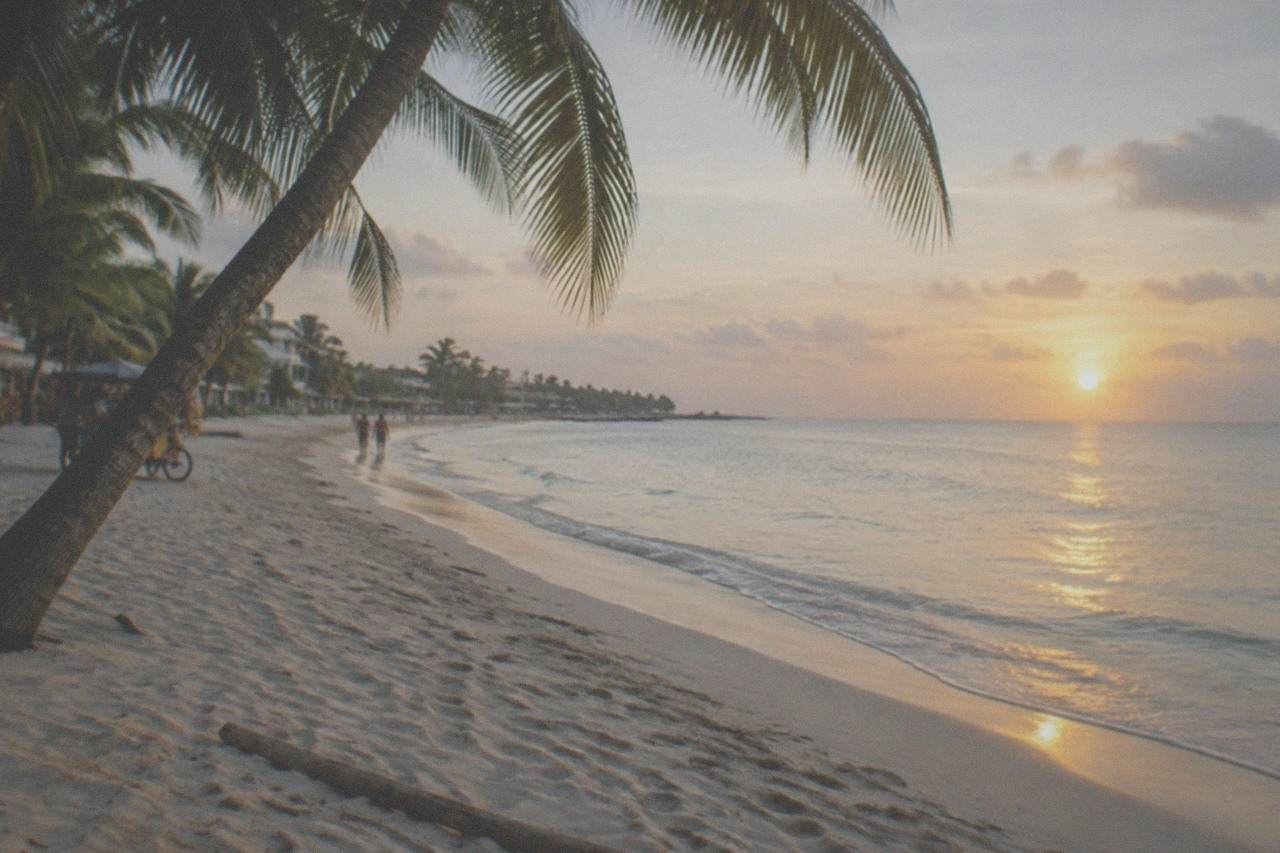
Yes, for most visitors who take normal precautions. Quintana Roo holds a Level 2 'exercise increased caution' advisory, and the violent incidents reported around Playa del Carmen in 2026 overwhelmingly involved local disputes rather than tourists. Stay in well-lit tourist zones after dark, use licensed transport, and guided tours cover the rest.
Quintana Roo, the state that holds Playa del Carmen, Cancun, Tulum and Cozumel, sits at Level 2 on the U.S. State Department's Mexico advisory scale: exercise increased caution. That is the same tier as Mexico overall, and the advisory language for this state is notably specific. It points to violent risk between criminal groups, notes that bystanders have occasionally been hurt, and tells visitors to pay attention to their surroundings after dark in downtown areas of Cancun, Tulum and Playa del Carmen, staying in well-lit pedestrian streets and tourist zones.
That is the honest headline. The rest of this guide unpacks what it means in practice, because a Level 2 advisory for a state of well over a million residents describes a very different lived reality in the beach and hotel zones than it does in the neighborhoods where the trouble actually happens.
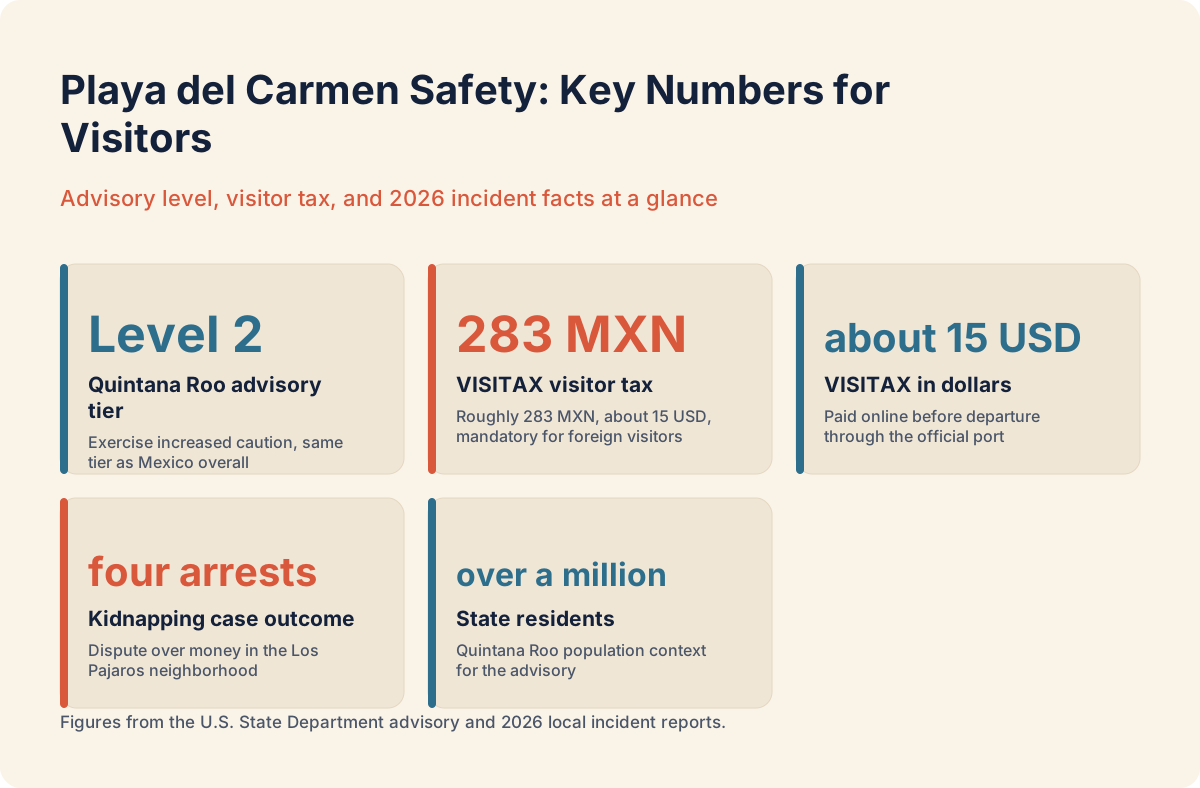
One official cost also belongs in any safety conversation, because it is the piece of paperwork that catches visitors at the airport. Quintana Roo charges VISITAX, a visitor tax of roughly 283 MXN, about 15 USD, mandatory for foreign visitors of all ages. Mexican nationals and residents are exempt. It is paid online before departure through the official VISITAX portal, which issues a QR code you show at departure, and it is generally not bundled into airfare.
So is Playa del Carmen safe? For the visitor who keeps ordinary city habits, yes. The violent incidents reported around town in 2026 were a kidnapping in a residential neighborhood that led to four arrests, a shooting at a late-night restaurant far from the tourist core, and a small number of targeted murders, all addresses with essentially nothing to do with the beach, Fifth Avenue or the hotel zones. None of it was aimed at tourists. The realistic daily risks are smaller and entirely manageable, and they are the subject of the next section.
Is Playa Del Carmen Safe For Tourists Right Now?
Yes, for the overwhelming majority of visitors. Quintana Roo holds a Level 2 "exercise increased caution" rating, the same tier as Mexico overall, and the state's advisory has held steady at that level through 2026. The violent incidents reported in and around Playa del Carmen this year overwhelmingly involved local disputes and targeted criminal activity, not visitors, and the beach and tourist zones stayed comparatively quiet.
A Level 2 advisory is a request for awareness, not a warning against travel. It is the tier the State Department uses for large parts of the world that receive millions of visitors a year, and the practical guidance inside it is unglamorous: stay aware after dark in downtown areas, keep to well-lit pedestrian streets, and use mainstream tourist zones. If you have visited Cancun or Tulum without incident, the same habits apply here.
What the 2026 local record shows is a pattern worth understanding rather than a threat to react to. The kidnapping arrests in September involved a dispute over money in the Los Pájaros neighborhood, inland and off any tourist map. The June armed attack targeted a restaurant with no connection to the beach zone. The two June murders were a residential case and a parking-lot shooting on a busy avenue, both resolved with a suspect returned from another state to face charges. These are real events, and they are the kind of events a city of this size unfortunately produces. They are not a pattern of visitor-directed crime.
The conclusion most careful readers reach is the one this guide is built around: Playa del Carmen rewards normal caution, punishes carelessness, and responds very well to structure. Pre-booked transport, vetted tours and a little seasonal awareness close most of the gap between a Level 2 advisory and a genuinely relaxed week on the coast.
What To Be Careful Of In Playa Del Carmen, Mexico?
The realistic worries are small and preventable: opportunistic pickpocketing on Fifth Avenue, aggressive timeshare and tour touts, taxi fare disputes, unlicensed jet-ski renters demanding damage fees, and rip currents on unpatrolled beach stretches. Violent crime against tourists is rare here. Nearly every reported incident in 2026 involved locals, disputes between residents, or targeted criminal business, not visitors.
Petty theft is the one risk almost every long-stay visitor eventually encounters indirectly. Crowded bars, the pedestrian stretch of Quinta Avenida, and the beach clubs are where phones vanish from tables and bags drift out from under chairs. It is the same risk profile as any busy resort street in the world. Front pockets, a crossbody bag and a phone that is not left face-up on a bar solve most of it.
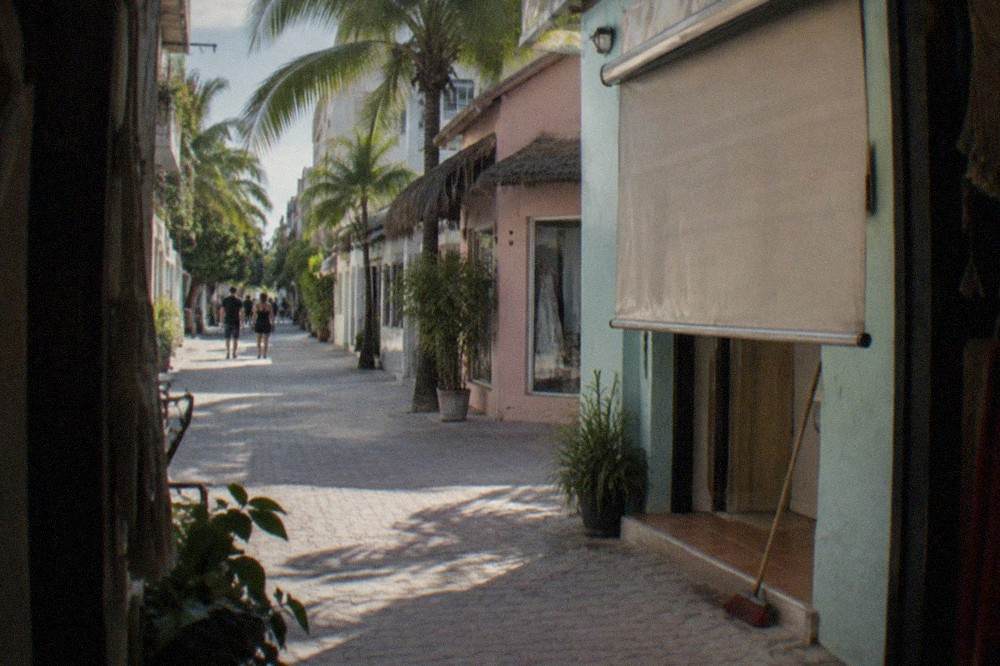
The touts are the second daily friction. Playa del Carmen has a persistent street pitch culture: free breakfast invitations, scratch cards that always win, discount tour vouchers that turn into timeshare presentations. None of it is dangerous. All of it eats a morning if you engage. A polite decline and a consistent walking pace work better than debate, and any tour worth taking can be booked through a vetted operator's live listing rather than a voucher on the street.
Water and beach behavior is the third category, and it is the one that turns serious fastest. Rip currents run along this coast, lifeguard coverage is uneven outside the main beach-club stretches, and flags change with conditions. Swim where flags are posted and enforced, ask locally about the day, and treat a red flag as a hard no. Sargassum, covered in full below, is mainly an expectation problem rather than a safety one, though heavy mats can cloud nearshore water in peak summer weeks.
| Risk | How it usually shows up | Realistic level | What to do |
|---|---|---|---|
| Pickpocketing | Crowded bars, Fifth Avenue, beach clubs | Low but real | Front pockets, crossbody bag, no phone on the table |
| Touts and timeshare | "Free breakfast" or scratch-card pitches on the street | Annoying, not dangerous | Decline politely and keep walking |
| Taxi fare disputes | No meter, price floated after the ride | Common | Agree the fare before getting in |
| Jet-ski and parasailing pressure | Unlicensed renters on the sand demanding damage fees | Occasional | Book through an operator, never a man on the beach |
| Rip currents | Red-flag days, unpatrolled stretches | Seasonal, serious | Swim between flags at lifeguarded beach clubs |
| Over-poured or suspect drinks | Unlicensed late-night spots | Rare | Stick to established venues |
None of these items requires changing your trip. They require about twenty minutes of habits. And several of them, particularly the vendor and transport frictions, simply disappear when a licensed, pre-booked tour is handling the logistics, which is why the guided route is worth considering even for travelers who normally shun organized anything.
Which Areas Should You Avoid In Playa Del Carmen After Dark?
The State Department's advice is specific: pay attention to your surroundings after dark in downtown areas and remain in well-lit pedestrian streets and tourist zones. In practice that means the Fifth Avenue corridor and the beach-hotel zones stay busy, lit and unremarkable late into the night, while quiet residential neighborhoods away from the water offer a visitor nothing and carry no reason to be there after sunset.
The honest answer to "which areas to avoid" is less dramatic than the question implies. There is no no-go district in Playa del Carmen's tourist footprint. There are simply places where the logic of a late evening changes. The pedestrian core between the ferry terminal and Constituyentes is the safest-feeling part of town at 11 PM precisely because it is the most crowded and most lit. Playacar, the gated hotel-and-residence zone south of town, is quiet rather than risky, but it is a taxi place after dark, not a walking place. The stretches of Calle Colosio and points south are mixed local-and-tourist and perfectly fine by day, but a taxi back costs little and removes the only meaningful exposure.
Where the 2026 incidents actually clustered tells the story. The kidnapping case, the restaurant shooting and the parking-lot murder all took place at addresses with no draw for a visitor: residential streets, an inland late-night eatery, a commercial avenue after hours. The violence that exists in Playa del Carmen is overwhelmingly dispute-driven and local. It does not follow tourists to Mamitas beach or the bars on 12th Street.
| Area | Character | Daytime | After dark |
|---|---|---|---|
| Fifth Avenue and Constituyentes | Pedestrian shopping and dining core | Busy and easy | Well-lit, patrolled, fine late |
| North beach and Mamitas | Beach clubs, boardwalk | Busy | Fine around open venues |
| Playacar | Gated hotel and residence zone south of the ferry | Calm, pleasant | Take a taxi, not a walk |
| Colosio corridor south | Mixed local and tourist | Fine | Taxi rather than walk |
| Inland residential neighborhoods | Where 2026 incidents actually clustered | No visitor draw | No reason to be there |
Two habits cover almost all of this. Move by taxi after dark when the distance is more than a few well-lit blocks, and treat any interaction that feels engineered, a too-friendly invitation, an unsolicited guide, as the street pitch it almost certainly is. Readers weighing the broader question of moving around the region independently will find leaving your resort in the Riviera Maya covered in detail elsewhere on this site; the short version is that independent movement is reasonable here, with the same after-dark rules applied.
Is It Safer To Book A Guided Tour Than To Explore On Your Own?
Yes, in most cases. A vetted tour replaces DIY decisions, street vendors and curb-side haggling with licensed transport, a guide who knows the site rules, insurance, and a group. On this site's roster the guided options also carry the deepest public review records, which functions as a running audit: an operator with four figures of reviews and a stable rating has been stress-tested by strangers.
Everything listed on Tours in Playa del Carmen is a vetted operator product, with the live review record printed beside each listing. When you are weighing whether a tour operator is trustworthy, two numbers matter more than any sales page: the rating and the review count together. A 5.0 from twelve reviews says almost nothing. A 5.0 from 1,341 reviews, which is exactly what the flagship Jungle Buggy Tour with cenote swim carries, from $110.16, says a great deal. That product is the roster's strongest combination of volume and rating, and it is a good template for what "vetted" looks like in practice: licensed vehicles, a fixed meeting structure, a guide on the cenote swim, and a paper trail thousands of guests deep.
The same logic scales up to the big day trips. The Chichen Itza, Cenote Ik Kil and Coba small-group early access tour runs 4.5 from 987 reviews, from $165, the deepest review pool among the ruins day trips, and it bundles the two things a DIY Chichen run gets wrong: the pre-dawn departure that beats both the heat and the buses, and the entry logistics at a site whose fee structure genuinely confuses first-time visitors. Structure is not just convenience on a ten-hour day; it is the version of the trip where nobody is negotiating anything from a curb at 6 AM.
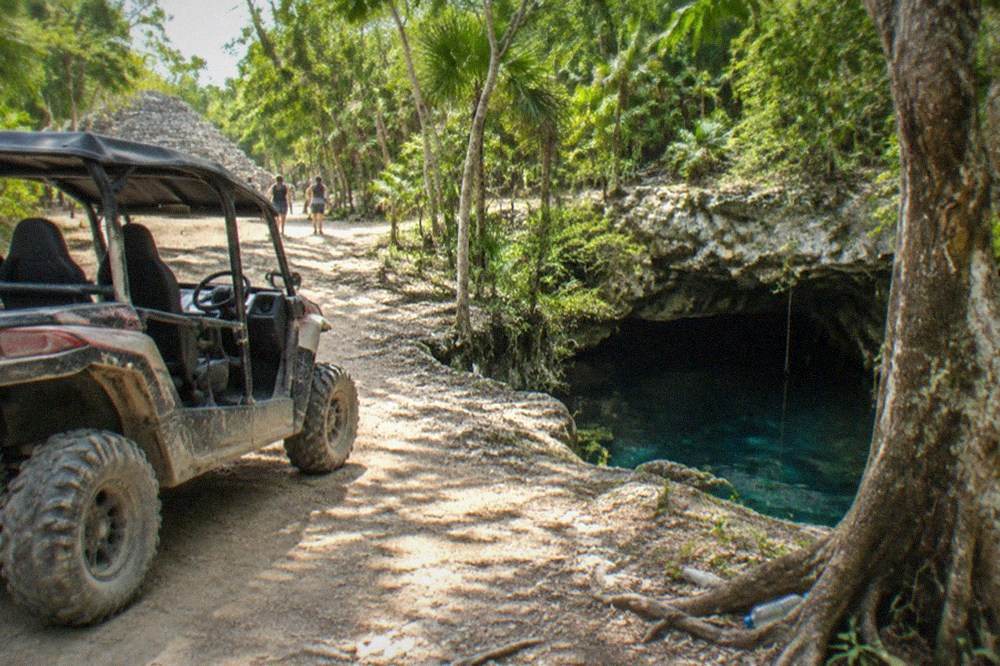
Guided does not mean passive, and it does not mean expensive, either. The roster spans everything from a $34.05 group day at Tulum and Cenote Mariposa, 4.6 from 446 reviews, to private cenote tours at the top of the range. The common thread is that someone licensed is driving, someone accountable is on the water with you, and the review record is public before you pay a peso. For a traveler whose main safety question is "will I be left to figure this out alone in a place I don't know," that is the whole answer.
Is It Safe To Swim, Snorkel And Visit Cenotes Around Playa Del Carmen?
Yes, with two conditions. Swim at patrolled, flagged beach stretches or in managed cenotes where rules are enforced, and never swim in the open sea on a red-flag day. Cenotes are generally the calmer choice: no currents, controlled access, and biodegradable sunscreen required or at minimum expected at most managed sites in Quintana Roo.
The open Caribbean side of the coast is where water risk lives. Currents shift with weather, flags matter, and lifeguard coverage outside the beach-club zones is thin. The cenote belt inland is a different proposition entirely: still, fresh water in cavern and open settings, run by operators who enforce showering, vest rules and guide requirements, and unaffected by sargassum or surf. For nervous swimmers and families, the cenotes are the safest water in the region, full stop. The deeper question of whether cenote swimming is safe has its own full write-up, including the wildlife and overhead-environment angles.
One rule genuinely changes outcomes: biodegradable, mineral-based sunscreen. It is not a single statewide law, but it is a widely enforced site-specific rule at most managed cenotes and marine parks in Quintana Roo, aimed at keeping oxybenzone and octinoxate out of fragile freshwater systems. Conventional sunscreen is commonly refused at the gate or triggers a mandatory rinse-off, and arriving with the right tube avoids both the delay and the argument. Buy it before you leave home; it is hard to find locally.
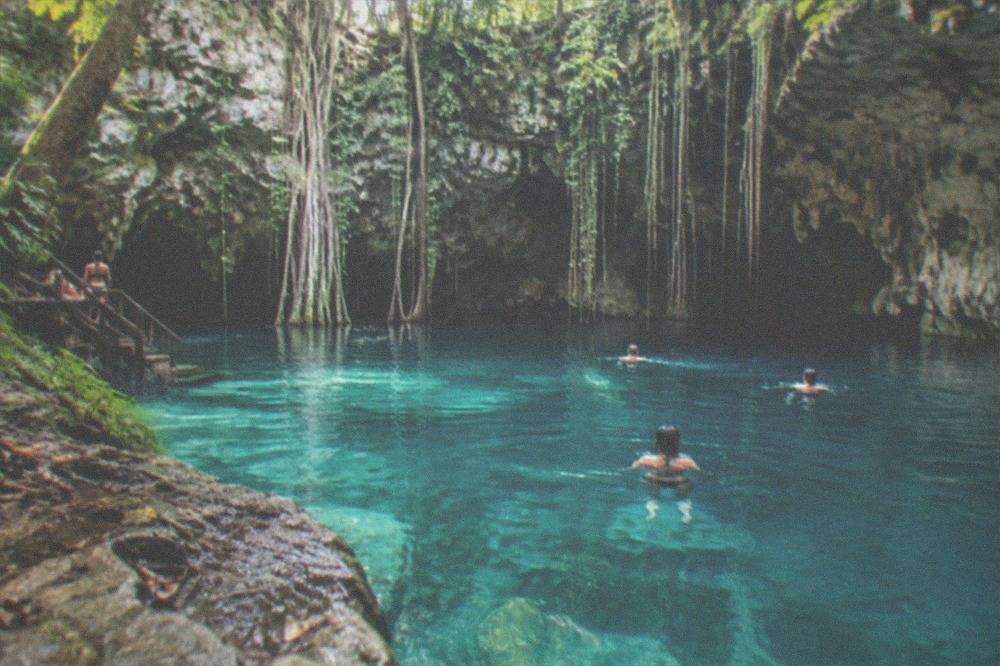
For a first cenote experience that carries its safety structure in the product itself, Rio Secreto is the model: a guided underground river tour, 4.6 from 198 reviews, from $119, with wetsuit, helmet, lamp and a guide required throughout, so the parts of a cave that reward caution are handled by design rather than improvisation. The current terms and availability sit on the operator's live listing.
One seasonal note on the sea, kept brief here because the season section covers it in full: heavy sargassum weeks in early summer can cloud nearshore water and occasionally reroute snorkel trips, and the reefs and offshore sites often stay clear when the beach line does not. If clear-water swimming is the priority, cenotes are the season-proof answer, and November through April is when the sea side is at its best.
Are There Any Areas To Avoid In Cozumel?
No go-zones, in the sense the question usually implies. Cozumel sits under the same Level 2 state advisory but reports lower violent crime than the mainland, with 2025 and 2026 complaints centered on petty theft and fraud rather than violence. The practical caution is logistics rather than geography: three cruise piers sit at very different distances from downtown San Miguel, so knowing which one you arrive at matters more than any neighborhood map.
Cozumel is, by the region's own reporting, one of its calmer corners, with a tourism economy that dominates island life and violent-crime levels that compare favorably to the mainland spots. The issues that reach English-language news from the island are overwhelmingly petty: card fraud, theft complaints, the occasional isolated incident. The serious question worth a read before a ferry ride is why Cozumel draws cartel scrutiny, which covers the one 2025 arrest case honestly and the broader dynamic behind the headlines; the short version is that scrutiny of transit routes does not translate into danger on the waterfront.
Getting there and around is simple. The passenger ferry from Playa del Carmen runs roughly every 30 to 60 minutes from about 7 AM to 10 PM, the crossing takes about 45 minutes, and a one-way adult fare runs roughly 250 to 344 MXN, about $12 to $22, depending on operator, class and whether you book online. Current sailings are listed on the ferry schedule page, and the terminal sits at the foot of Fifth Avenue, so there is no sketchy transfer between your hotel and the boat.
| Arrival point | Where it puts you | Getting to downtown San Miguel |
|---|---|---|
| Playa del Carmen ferry terminal | Calle 1 at the foot of Quinta Avenida | You are already in Playa; the crossing itself is about 45 minutes |
| Punta Langosta pier | Directly at the edge of downtown | Walk, under 10 minutes to shops and the malecón |
| International/SSA pier | South of town | Taxi, about 10 to 12 minutes |
| Puerta Maya pier | South of town | Taxi, about 10 to 12 minutes |
On the island itself, the same two habits from Playa apply: the tourist core is walkable day and night, and the standard after-dark awareness the State Department describes for the region is about street sense, not avoidance. If your day on Cozumel is built around snorkeling, the island's premier sites, Palancar and Colombia reefs on the southwest coast, sit offshore and away from any populated area entirely, which is most of the reason boat-based snorkel days there feel so low-stress.
What Is The Safest Way To Get Around Playa Del Carmen?
Licensed and pre-booked options, in one line. ADO buses and colectivos are the workhorses, frequent and inexpensive, while a pre-arranged private transfer beats curbside negotiation for airport arrivals. Taxis are fine in town once the fare is agreed first. The one 2026 caution is specific: violence directed at ride-hailing drivers on Highway 307 makes licensed options the safer default on that road.
Playa del Carmen is one of the easiest towns in the region to move through, because the formal transport layer is genuinely good. ADO runs modern, air-conditioned buses with luggage holds multiple times an hour on the key routes, the colectivo vans leave when full and cost a few dollars, and the airport transfer market has real, bookable operators rather than only curb-side touts. The full breakdown of getting from Cancun airport to Playa del Carmen is a separate guide; the cost and time picture looks like this.
| Option | Typical cost | Time | Notes |
|---|---|---|---|
| ADO bus, airport to Playa | 232-270 MXN, roughly $11-14 per person | 1-1.75 hours | Air-conditioned, luggage hold, frequent |
| Colectivo, Playa to Tulum | 50-80 MXN, roughly $3-4 per person | 1-1.5 hours | Leaves when full, stops on request |
| Private transfer, airport to Playa | Roughly $70-88 per vehicle | 60-75 minutes | Door to door, book ahead, groups of up to 8-10 |
| Taxi, in town | Agree the fare first | Short hops | Use taxi stands, not cruisers |
| Rental car | Varies widely | Flexible | Factor insurance, fuel, parking and night driving |
The 2026 wrinkle deserves one honest paragraph rather than a shrug. In mid-September, gunmen fired on ride-hailing drivers along the Playa del Carmen to Tulum federal highway near Xpu-Ha, in violence reported as tied to the taxi-union conflict over that corridor. No tourist mechanism was involved, and no similar incident has been reported since. But the practical takeaway writes itself: on Highway 307, use ADO, colectivos, licensed taxis or pre-booked tour transport, all of which are cheaper or equal anyway, and save the app-based ride for short hops inside town if you use one at all.
Inside Playa itself, walking is the main mode and the right one. The tourist core is flat, compact and pedestrianized, and the farther reaches are taxi territory at night on cost grounds alone. Rental cars reward the cenote-and-ruins travelers who want to move on their own schedule, with the standing caveats for the region: full insurance, no night driving on unfamiliar roads, and secure parking at cenotes rather than roadside.
Are Day Trips From Playa Del Carmen Safe?
Yes. The headline routes, Chichen Itza, Tulum and the cenote belt, run along well-traveled toll highways with heavy tour traffic, and operators bundle licensed transport, entry logistics and a guide. The one 2026 wrinkle worth knowing: Chichen Itza closed temporarily from mid-May to June 1 in a dispute tied to the new visitor center, then reopened with access routed through that facility and no change to the core rules.
The drive that worries people, the run to Chichen Itza, is about 182 km each way via toll road, typically 2 to 2.5 hours one way, and it is one of the most tour-trafficked routes on the peninsula. Full-day guided tours from Playa commonly run 10 to 11 hours door to door, with pickup around 7 to 8 AM and return by early evening, which is exactly the kind of fixed structure that suits a long, hot day. The site itself is open daily 8 AM to 5 PM, climbing El Castillo has been prohibited for years and is actively enforced, and foreign adult entry runs a combined total of roughly 676 to 697 MXN, with children under 13 often free.
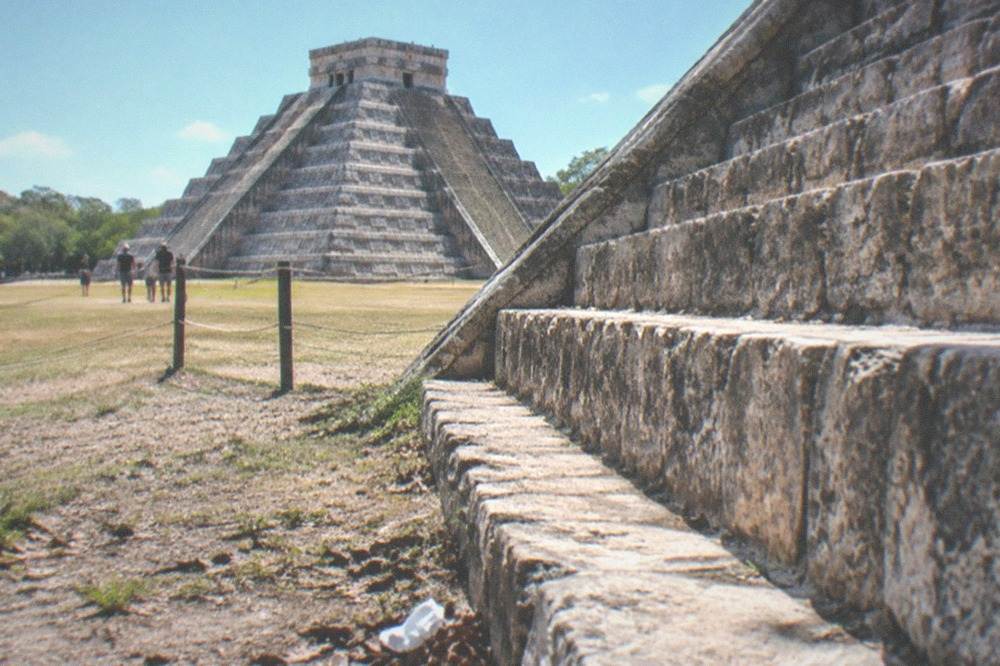
For the guided version with the deepest review trail on this roster after the flagship, the Chichen Itza, Valladolid, Cenote and Buffet day runs 4.5 from 954 reviews, from $93, and covers the three legs first-timers underestimate: the early start, the entry process, and the fact that a June afternoon at the site is brutal without a swim and a proper lunch built into the day. The current terms and availability sit on the operator's live listing.
Closer to town, the same verdict applies at shorter range. Tulum is 50 to 75 minutes down Highway 307 with ruins entry fees running roughly $15-30 in combined components, never one fixed number, and the cenote belt sits within 15 to 40 minutes of the center. Akumal, about 25 to 35 minutes south, deserves one specific note repeated from above only in brief: the turtle-swim program pauses each September, and current bookable alternatives there are boat and lagoon trips. None of these day-trip corridors carries the ride-hailing caution; they carry tour vans, colectivos and rental cars, in that order of convenience.
Which Season Is Safest For Visiting Playa Del Carmen?
November through April. That is the regional dry season, fully outside the official June 1 to November 30 Atlantic hurricane season, and the cleanest stretch for sargassum. The May to October rainy season brings afternoon showers, humidity, and the August to October hurricane peak, along with sargassum's worst weeks in June through August, though 2026 arrivals were easing sharply by late September.
The official anchor for the storm question is the NOAA definition of the Atlantic hurricane season, June 1 through November 30, with peak activity typically August through October. The regional dry season, roughly November to April, is when rainfall and humidity drop and when the Caribbean side of the coast is at its calm, clear best. That is the window to build a first trip around if flexibility exists, and it is no coincidence that it is also the busiest.
| Period | Weather | Sargassum | Hurricane exposure |
|---|---|---|---|
| November-April, dry season | Lower rain, comfortable | Generally the cleanest | Outside the official season |
| May-July | Hot, afternoon showers build | Rising to the June-August peak | Low to moderate, rising |
| August-October | Hot, humid, stormy spells | Declining from the peak | The season's peak window |
Rainy season is not a reason to cancel a trip, and it is worth saying plainly what it actually looks like: hot, humid mornings, afternoon showers that can be intense and short, and water clarity that varies week to week with the sargassum cycle. 2026 has been a heavy sargassum year, with record collections in the state through mid-September and Playa del Carmen the most affected municipality, but the state's own monitoring showed volumes falling steeply from August into late September. Cenotes, inland and unaffected, are the rainy-season hedge: the water is just as clear in July as in January.
Whatever the season, the same three tours keep coming up in the safety conversation, because they combine the region's deepest review records with the kind of structure this whole guide points toward. The Jungle Buggy Tour with cenote swim leads at 5.0 from 1,341 reviews, from $110.16. The Chichen Itza, Cenote Ik Kil and Coba small-group day runs 4.5 from 987 reviews, from $165. The Isla Mujeres catamaran cruise with beach club and open bar holds the roster's largest review pool at 2,618 reviews with a 4.0 rating, from $59, a fact best read as a hugely popular product whose rating sits below the roster's strongest rather than as a warning.
Common Questions About Playa Del Carmen Safety
Is Playa del Carmen safe for tourists?
Yes, with normal precautions. Quintana Roo holds a Level 2 "exercise increased caution" advisory, the same tier as Mexico overall, and the violent incidents reported around Playa del Carmen in 2026 involved local disputes rather than visitors. Keep to well-lit tourist zones after dark and use licensed transport, and the risk profile is that of an ordinary resort city.
What to be careful of in Playa del Carmen, Mexico?
Petty theft in crowded spots, timeshare and tour touts, taxi fares that must be agreed before the ride, unlicensed jet-ski renters demanding damage fees, and rip currents on unpatrolled beach stretches. Violent crime directed at tourists is rare. The habitual precautions are front pockets, booked vendors, flagged swimming and a taxi after dark.
Are there areas to avoid in Playa del Carmen after dark?
No no-go zones within the tourist footprint, but the State Department's guidance applies: stay in well-lit pedestrian and tourist zones after dark. Fifth Avenue and the beach-club core are fine late. Playacar and the southern stretches are taxi territory at night, and the inland residential neighborhoods where 2026 incidents clustered offer a visitor nothing at any hour.
Are there any areas to avoid in Cozumel?
No neighborhoods to avoid. Cozumel reports lower violent crime than the mainland, with recent complaints centered on petty theft and fraud. The practical caution is arrival logistics: Punta Langosta pier sits within a short walk of downtown San Miguel, while the International/SSA and Puerta Maya piers are about a 10-12 minute taxi ride south of town.
Do I need to pay the VISITAX visitor tax?
Yes, if you are a foreign visitor of any age. The tax runs roughly 283 MXN, about 15 USD, is paid online before departure through the official portal for a QR code, and is generally not bundled into airfare. Mexican nationals and residents are exempt.